
Mercury
The Sun-Kissed Cinder Mercury is a world of stark contrasts, a heavy iron heart wrapped in a thin, scarred mantle. With no atmosphere to protect it, it bears the impact of every cosmic collision in its history. During the day, the sun looms three times larger than it does on Earth, bathing the surface in radiation, while the nights plunge into a deep, absolute frost. It is the solar system’s most resilient survivor, orbiting in a perpetual, high-speed chase around our star.

Venus
The Golden Pressure Cooker Often called Earth’s "Evil Twin," Venus is a masterpiece of atmospheric chaos. Beneath its beautiful, yellowish clouds of sulfuric acid lies a surface hot enough to melt lead. The atmospheric pressure is so intense it would feel like being 3,000 feet underwater. On Venus, the sun rises in the west and sets in the east, glowing dimly through a perpetual, heavy haze of golden light and volcanic heat.

Earth
The Living Masterpiece From the deep cerulean of the Pacific to the swirling white marbles of its cloud cover, Earth is the solar system’s only canvas painted with the colors of life. It exists in the "Goldilocks Zone"—not too hot, not too cold—allowing liquid water to carve its landscapes and sustain its billions of inhabitants. It is a fragile, breathtaking anomaly in the silence of the void.

Mars
The Rust-Hued Frontier Mars is a world of ancient geological wonders. It hosts Olympus Mons, a volcano three times the height of Everest, and Valles Marineris, a canyon that would stretch across the entire United States. Its pinkish skies and blue sunsets are the result of fine iron-oxide dust suspended in a thin atmosphere. Mars remains the most hauntingly familiar world, a desert planet that once held the promise of seas.

Jupiter
The King of Storms Jupiter is a massive ball of hydrogen and helium, so large that all other planets could fit inside it twice over. It has no solid surface; instead, it is a world of crushing depths and kaleidoscopic clouds. Its iconic Great Red Spot is a cyclonic storm that has been spinning for centuries. With over 90 moons, Jupiter functions like a mini-solar system, a gravitational anchor for the entire cosmic neighborhood.

Saturn
The Crowned Jewel Saturn is perhaps the most recognizable object in the night sky. Its ring system, spanning 175,000 miles but only about 30 feet thick in places, is composed of billions of individual ice chunks and rock fragments. The planet itself is a pale gold gas giant, whipped by winds reaching 1,100 mph. It is a world of exquisite symmetry and delicate, icy beauty.
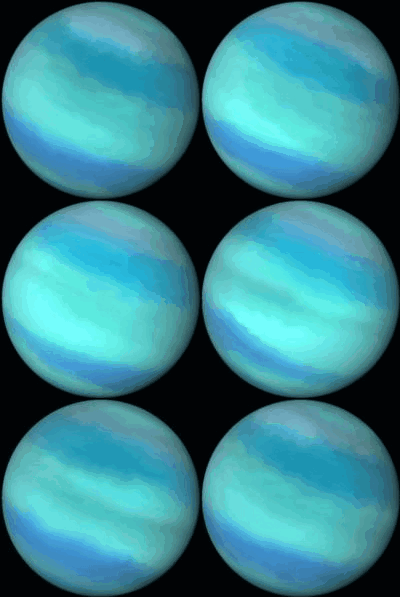
Uranus
The Ice Giant Uranus is a frozen world of methane and ice, spinning on its side like a cosmic top. Its pale blue-green hue comes from methane in its atmosphere, which absorbs red light and reflects blue. It has a faint ring system and 27 known moons, including Miranda, which has a surface so strange it looks like it was assembled from puzzle pieces.
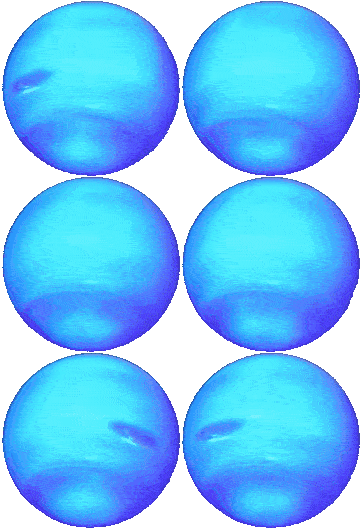
Neptune
The Deep Blue Giant Neptune is a frozen world of methane and ice, spinning on its side like a cosmic top. Its pale blue hue comes from methane in its atmosphere, which absorbs red light and reflects blue. It has a faint ring system and 14 known moons, including Triton, which orbits in the opposite direction of Neptune's rotation.